
Have you ever asked your child a simple question and gotten an answer that seemed completely unrelated? Or watched your child struggle to explain something they clearly understood? Maybe they know the answer but cannot find the right words, tell a story in the right order, or explain their thinking. These challenges can be confusing for parents—and they can be even more frustrating for children.
From an SLP perspective, these difficulties may involve language processing and expressive formulation. These are complex neurological processes that allow children to take in information, make sense of it, organize it, and formulate a response.
And importantly, language processing is much more than simply “understanding words.”
What are Language Processing & Expressive Formulation?
Language processing is the process of receiving and interpreting information—whether that information is spoken, written, or presented through another form of communication. It helps a child answer questions, follow directions, learn new information, understand stories, make connections between ideas, and figure out what someone means.
Expressive formulation is what happens when a child takes what they know and turns it into a response. This includes finding the words they need, organizing their ideas, putting words together, and communicating their thoughts clearly.
Think of it this way:
Language processing = “What does this information mean?”
Expressive formulation = “How do I turn what I know into something I can communicate?”
These two processes are closely connected. A child may have difficulty with one, the other, or both.
Language Skills Don't Develop in Isolation
One of the most important things to understand about language is that communication skills are interconnected. A child may have strong vocabulary but struggle to organize a story. Another child may understand a story but have difficulty explaining what happened. A child might know exactly what they want to say but struggle to retrieve the words quickly enough to say it.
Why? Because language processing and expressive formulation depend on many underlying skills.
The graphic below illustrates some of these relationships. I think of them as four levels of increasingly complex skills.
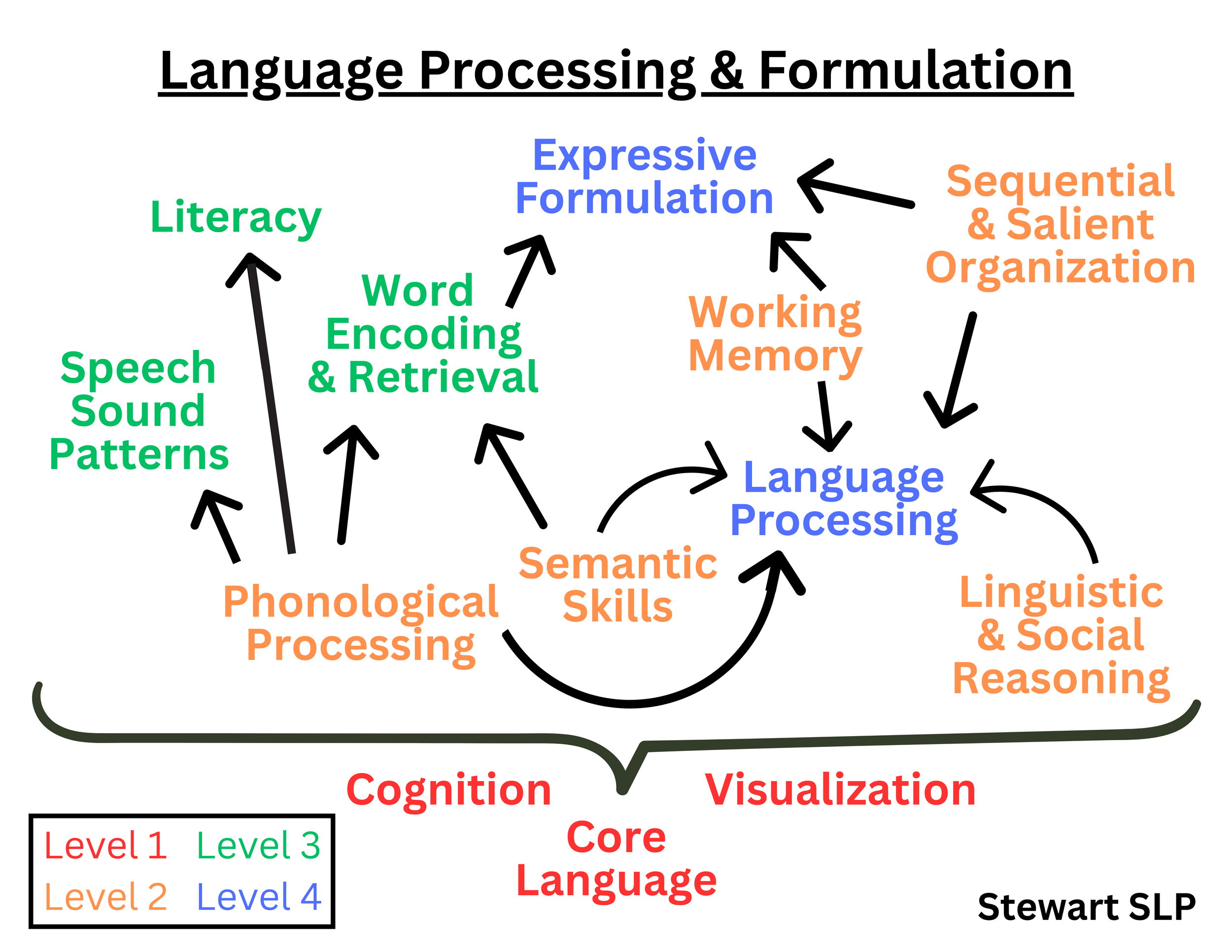
Level 1: The Foundation
At the bottom of the language system are three foundational areas:
Cognition
Core Language
Visualization
These skills support everything else.
Cognition
Cognition includes the mental processes we use to pay attention, learn, remember, problem-solve, make connections, and think flexibly. For example, when a child is learning a new concept, they need to be able to pay attention to the information, hold onto it, connect it to what they already know, and use it later.
Core Language
Core language includes the fundamental language knowledge that allows us to understand and use language. This includes things such as vocabulary, grammar, sentence structure, and the relationships between words and concepts.
Visualization
Visualization is our ability to create mental pictures or representations of information. For example, when someone says, “The boy put the red ball under the chair,” a child may need to mentally picture the boy, ball, chair, and their locations in order to fully understand the message. Visualization can be particularly helpful for understanding stories, directions, concepts, and language that describes relationships between objects or ideas.
When these foundational skills are developing, other language skills may be affected as well.
Level 2: The Building Blocks of Language Processing
The next level includes several skills that directly and/or indirectly support language processing and expressive formulation:
Phonological Processing
Semantic Skills
Working Memory
Linguistic & Social Reasoning
Sequential & Salient Organization
Each plays a different role.
Phonological Processing
Phonological processing is our ability to notice, remember, and work with the sounds in spoken language. This includes skills such as recognizing that cat and car start with the same sound, breaking words into sounds or syllables, and remembering the sound patterns of words. Phonological processing is especially important for speech sound development, word learning, and literacy.
Semantic Skills
Semantics refers to meaning. Children use semantic skills to understand what words mean, how words relate to one another, and how ideas connect. For example, a child needs to understand that dog is an animal, that a puppy is a young dog, and that a dog can bark, run, eat, and sleep. Strong semantic connections make it easier to learn new vocabulary and retrieve words when we need them.
Working Memory
Working memory allows us to temporarily hold information in our minds while we use it. Imagine telling your child: “Go upstairs, get your shoes, bring them downstairs, and put them by the door.” Your child has to remember several pieces of information while completing the task. Working memory also plays an important role in conversation. A child needs to remember what someone just said while thinking about what they want to say in response.
Linguistic & Social Reasoning
Language isn't always literal. Children need to use language and social information to make inferences, understand other people's perspectives, figure out what someone means, and interpret information that isn't explicitly stated. For example: “It's getting pretty loud in here.” The speaker may not simply be making an observation. They may be communicating that they want the noise level to decrease. Linguistic and social reasoning helps children understand those kinds of implied messages.
Sequential & Salient Organization
Children also need to organize information. Sequential organization involves understanding and remembering information in the correct order. Salient organization involves recognizing what information is most important or relevant. These skills are critical for things like telling a story, explaining how to complete a task, summarizing a lesson, or answering a question without getting lost in unnecessary details.
Level 3: Skills That Grow From the Foundation
Some skills are built from the Level 2 foundational processes.
Speech Sound Patterns
Phonological processing contributes to the development and organization of speech sound patterns. A child who has difficulty processing and organizing speech sounds may have difficulty learning or consistently producing particular sound patterns.
Literacy
Phonological processing is also a major foundation for literacy. Children need to notice and manipulate sounds in spoken words as they learn how those sounds connect to letters and written words. This is one reason speech-language development and literacy development are so closely connected.
Word Encoding & Retrieval
To use a word, a child first needs to learn and store it and then be able to retrieve it when needed. This process draws on both phonological and semantic information. For example, a child may know that an animal lives in the ocean, is very large, and has a blowhole—but still struggle to retrieve the word whale. You may hear: “You know… the big ocean animal… the one that goes whoosh…” The child knows the concept. The problem is accessing the word. This is an important distinction: difficulty retrieving a word does not necessarily mean a child doesn't know the word.
Level 4: Language Processing & Expressive Formulation
At the top of the graphic are the complex skills we use to successfully understand and communicate language.
Language Processing
Successful language processing draws on:
Phonological processing
Semantic skills
Working memory
Linguistic and social reasoning
Sequential and salient organization
This allows a child to take in information and make sense of it. For example, when a teacher says, “After you finish your math worksheet, put it in your blue folder and bring it to the front table,” the child isn't simply listening to words. They are processing the meaning, remembering the instructions, identifying what needs to happen first, keeping the information in working memory, and determining which details matter.
Expressive Formulation
Expressive formulation draws heavily on:
Word encoding and retrieval
Working memory
Sequential and salient organization
This allows a child to turn their thoughts into a meaningful response. For example, if you ask, “What did you do at school today?” your child needs to decide what happened, determine which parts are important, retrieve the words they need, organize the events, hold their ideas in working memory, and formulate sentences. That's a surprisingly complicated task for a question that sounds simple!
Why a Child May “Know It” But Not Be Able to Say It
This is one of the most important concepts for parents to understand. Sometimes a child's performance doesn't accurately reflect what they know.
A child might:
Know the answer but struggle to explain it.
Understand a story but have difficulty retelling it.
Know a word but not be able to retrieve it quickly.
Understand a direction but forget part of it before completing it.
Have a large vocabulary but struggle to organize a narrative.
Know what happened but tell the story out of order.
Understand what someone said but miss the implied meaning.
Have good conversational skills but struggle with language-heavy academic tasks.
These difficulties can be especially noticeable as children get older because the language demands of school and everyday life become increasingly complex. A kindergarten child might need to follow a two-step direction. An older student may need to listen to a 20-minute lecture, remember the important information, connect it to previous learning, take notes, and later explain the concept in writing. The underlying language system is doing a lot of work.
Why SLPs Look Beyond the “Obvious” Problem
When a child has difficulty answering questions, telling stories, following directions, or expressing ideas, it can be tempting to focus only on the skill that is most noticeable.
But an SLP may ask: What is making this difficult? For example, if a child struggles to tell a story, we might look at:
Do they understand the vocabulary?
Can they remember the events?
Can they identify the most important information?
Can they organize events in sequence?
Can they retrieve the words they need?
Can they hold their ideas in working memory while forming sentences?
Can they infer what the listener needs to know?
Can they visualize the events?
The goal isn't simply to teach a child to tell a better story. The goal is to understand which underlying skills are making storytelling difficult and support those skills.
It's a Network, Not a Staircase
Although the graphic is organized into levels, development doesn't actually happen in four perfectly separate steps. These skills interact and intersect. A child may have strengths in some areas and weaknesses in others. One child may have difficulty primarily with word retrieval, while another may struggle more with working memory or organization. A third child may have difficulty across several interconnected areas. This is why two children can appear to have the same problem but need very different support.
For example, two children may both struggle to answer open-ended questions. One may need support with word retrieval. Another may understand the vocabulary but have difficulty with working memory and organizing ideas. Another may have difficulty with linguistic reasoning and not fully understand what the question is asking. On the surface, the difficulty looks similar. Underneath, the language systems involved may be quite different.
What Parents Can Do at Home
You don't need to turn everyday life into speech therapy to support language processing and expressive formulation. In fact, some of the best opportunities happen naturally.
Give your child time to formulate: If your child is struggling to find a word or explain something, try giving them a few extra seconds before jumping in.
Help organize information: When your child tells you a complicated story, you can gently help organize it, as in, “First you went outside. What happened next?” or “That sounds important. Tell me more about that part.”
Make connections: Help your child connect new information to things they already know: “Remember when we saw that at the zoo? This is similar because…”
Encourage visualization: When reading or talking about something, ask, “What do you picture?” or “What do you think that looked like?”
Talk about the “why”: Instead of asking only factual questions, explore reasoning: “Why do you think she did that?”; “How do you think he felt?”; “What makes you think that?”
Don't mistake difficulty for lack of knowledge: If your child is struggling to explain something, consider whether they may know more than they are able to express at that moment. Sometimes a little extra time, a visual, a choice between words, or a question that helps organize their thinking can reveal just how much they actually understand.
When Language Processing Becomes a Concern
Every child occasionally forgets a word, loses their train of thought, gives a disorganized answer, or needs a direction repeated. The bigger question is whether these difficulties are persistent, interfere with daily life or learning, and occur across settings or types of communication.
An SLP can help determine whether a child's difficulties are related to language processing, expressive formulation, speech sound development, literacy, attention, memory, or another underlying skill—and, importantly, how those areas interact.
The big picture matters. Children don't learn language skills one at a time in isolation. They build an interconnected communication system in which cognition, language, memory, organization, reasoning, phonological processing, word retrieval, and visualization all work together. When we understand that system, we can move beyond simply asking, “Why can't my child answer this question?” Instead, we can ask the much more helpful question: “What does my child need in order to understand, organize, and express what they know?”
That shift can make a tremendous difference—not only in how we support children, but in how children understand themselves as communicators. A child who struggles to express an idea isn't necessarily a child who doesn't have the idea. With the right support for the underlying skills, children can become more confident, capable, and effective communicators.
Need More Individualized Support?
At Stewart SLP, we help children and adolescents develop speech, language, communication, and language-based learning skills through individualized, evidence-based therapy.
We serve families in Huntington Woods, Royal Oak, Berkley, Ferndale, Birmingham, Oak Park, Troy, Detroit, and surrounding communities.