
We all have different kinds of relationships in our lives, from the people we are closest to and share the most with to people we barely know. These relationships can change over time, which can make it tricky to know where someone fits—and what we should or shouldn’t talk about with them. For children, understanding these differences can be especially challenging.
One helpful way to teach children about different levels of relationships and appropriate conversation topics is through Privacy Circles. Privacy Circles use a series of concentric circles, with ourselves at the center. The people closest to us are in the circles nearest to us, while less familiar or more distant relationships are placed in circles farther away. Each circle can also be connected to different types of information and conversation topics that are appropriate to share at that level of closeness. By identifying the different circles and thinking about who belongs in each one, children can begin to understand who they can talk to about different things, what information is appropriate to share, and when a topic might be too personal for a particular relationship.
When we introduce Privacy Circles in therapy, we often start by creating a large set of circles—like a target—on a piece of poster board. We give each circle its own color and talk together about the different types of relationships in the child’s life. Because every child and family is different, we can adjust the circles to reflect their individual experiences and relationships.
While the specific circles may vary, many Privacy Circles include the following layers, moving from the center outward:
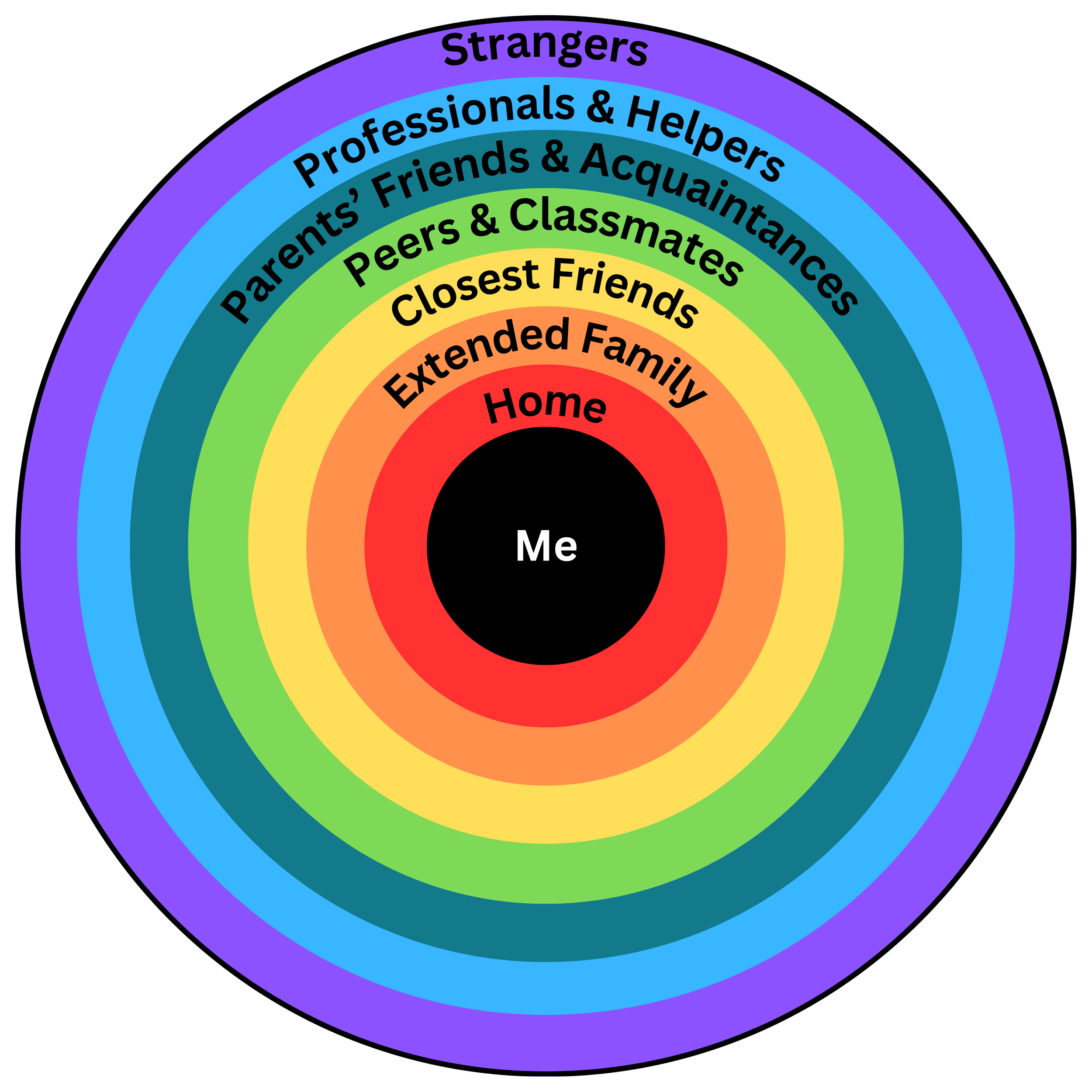
1. Self — The center circle represents the child. This is the most private circle.
2. Home/Household & Immediate Family — The people the child lives with and sees regularly at home.
3. Extended Family — Relatives such as grandparents, aunts, uncles, and cousins.
4. Closest Friends — Friends the child knows well and trusts.
5. Peers & Classmates — Children the child sees at school or in other activities but may not know as well.
6. Parents’ Friends & Acquaintances — Adults the child may recognize or interact with because of their family, but who are not close friends or family members.
7. Professionals & Helpers — People whose job is to help or support the child, such as teachers, doctors, therapists, or other familiar or unfamiliar professionals.
8. Strangers — People the child does not know.
Once we’ve created the Privacy Circle poster, we work together to identify the people who belong in each layer. We write each person’s name on a separate small card, laminate the cards, and use Velcro to attach each name to the appropriate part of the circle.
An important part of this process is helping children understand that relationships are not always fixed. People can move closer to us or farther away over time, and our feelings toward someone can change from day to day. To help make this visible, we use the left side of each circle for people we are feeling less positively toward in that moment and the right side for people we are feeling more positively toward.
We check in about these relationships regularly. A child might be frustrated with their very best friend one week, for example, but that doesn’t necessarily mean the friend has moved to a different relationship layer. Their feelings may change while the underlying relationship stays the same. On the other hand, a classmate might gradually become a close friend, while a close friendship might naturally become more distant over time.
The Velcro names make these changes easy to see. Children can physically move people around their Privacy Circle as relationships change, helping them understand that relationships can be both stable and flexible—and that changing feelings don’t always mean changing relationships.
Privacy Circles can do more than help children understand different levels of relationships. They can also help children learn which topics are appropriate to discuss with different people. This is an important skill for both social communication and personal safety. For example, it may be perfectly appropriate to share your birthday with family and friends, but not with a stranger. A child should be able to tell a parent or doctor about a health or body concern, while that same information may not be appropriate to share with a classmate.
When we teach conversational topics using Privacy Circles, we start by creating a list of topics that makes sense for the child’s age, experiences, and individual needs. We might include topics such as:
Personal information: your name, birthday, address, school, and family
Safety and boundaries: who can touch you, who can see your body, who you can ride in a car with, and who can pick you up from school
Private information: passwords, secrets, health concerns, and emotional challenges
Personal thoughts and feelings: worries, fears, family problems, or things that are bothering you
Hygiene and body topics: periods, showers, deodorant, body functions, and other personal-care concerns
Friendships and relationships: crushes, dating, and questions about other people’s relationships
Everyday conversation: the weather, what you did over the weekend, hobbies, sports, and favorite things
Entertainment: movies, books, games, music, TV shows, and social media
School: homework, teachers, classmates, and asking for help
More sensitive or situational topics: money, religion, news, swearing, and talking about other people
Emergency and safety situations: who to ask for help when you are scared, worried, lost, or in danger
We then go through these topics one at a time and role-play conversations with people from each layer of the Privacy Circle. Together, we consider questions such as, “Would you talk about this with your best friend? What about your teacher? What about a stranger?” We keep track of the child’s answers on a topic chart so we can practice and revisit these skills over time.
Parents are an important part of this process, too. Families can help us understand which social situations are challenging for their child and which topics may need extra attention. They can also help children apply what they are learning in therapy to real-life conversations at home, school, and in the community.
The goal isn’t to teach children that certain topics are simply “good” or “bad.” Instead, we want them to develop a flexible understanding of what information is appropriate to share, with whom, and in what situations—a skill that supports both healthy relationships and personal safety.
Privacy Circles are a practical, flexible tool for helping children understand relationships, personal boundaries, and appropriate communication. By identifying the different people in a child’s life, exploring how relationships and feelings can change, and practicing which topics are appropriate to share with different people, children can develop a clearer understanding of social expectations and personal safety. Most importantly, Privacy Circles give children a concrete, visual way to talk about relationships and communication skills that can otherwise feel abstract or confusing. With practice, children can use these skills to build stronger relationships, communicate more confidently, and feel more comfortable navigating the many different social connections in their lives.
Need More Individualized Support?
At Stewart SLP, we help children and adolescents develop speech, language, communication, and language-based learning skills through individualized, evidence-based therapy.
We serve families in Huntington Woods, Royal Oak, Berkley, Ferndale, Birmingham, Oak Park, Troy, Detroit, and surrounding communities.