
As the winter holidays approach, we’re often asked for gift recommendations that support children’s communication. Some of the best gifts for growing communication skills are the ones that give children something interesting to notice, explore, create, and share. A good book, a simple toy, or a memorable experience can spark conversations that continue long after the gift is opened.
Here are some favorites for different ages, along with easy ways to use them to encourage communication. Choose according to your child’s interests and developmental needs, and remember that communication includes gestures, signs, AAC, writing, and spoken words.
Enjoy connecting!
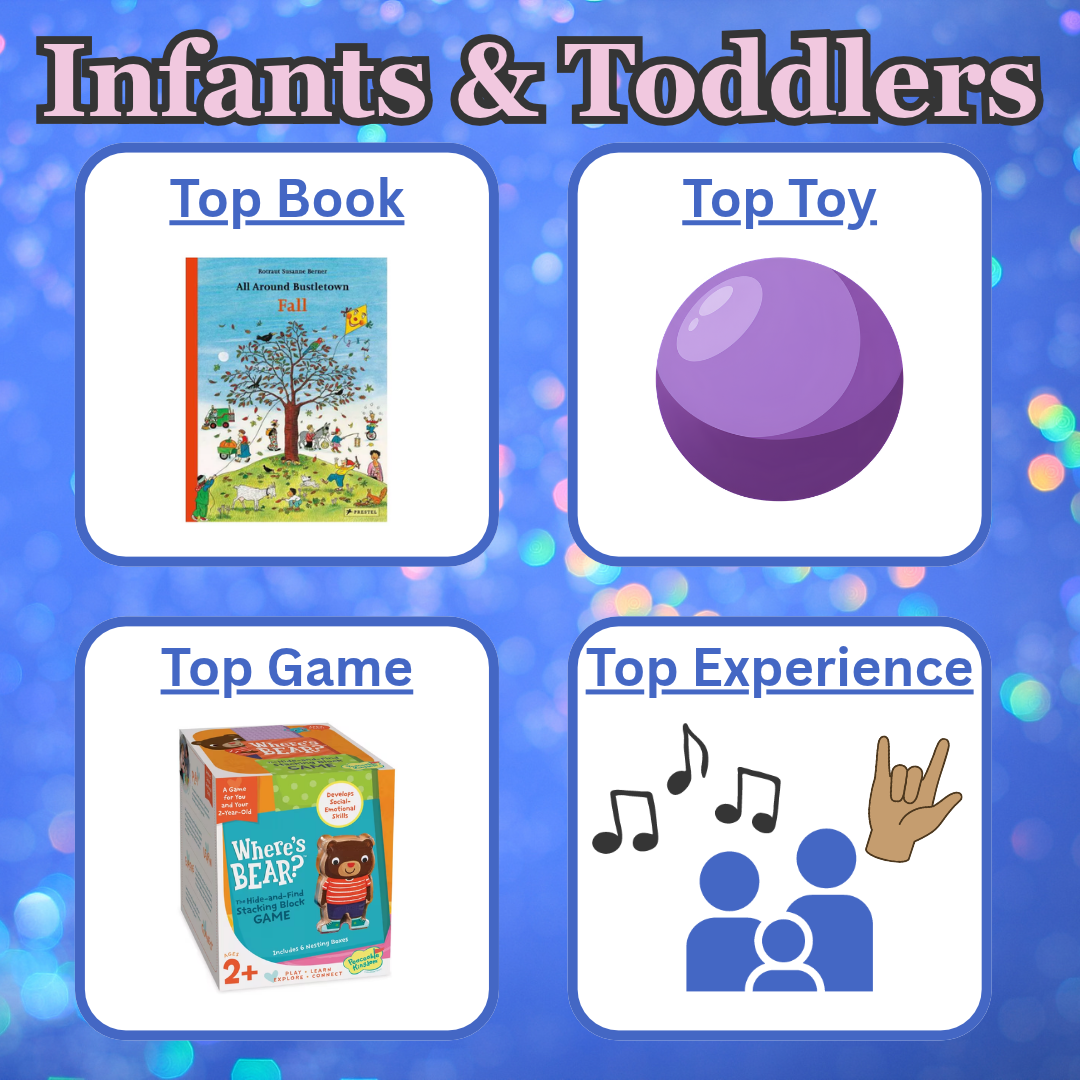
Infants & Toddlers
Top book: All Around Bustletown, by Rotraut Susanne Berner
The detailed illustrations in this series offer something new to discover every time you open a book. Familiar places, everyday activities, and recurring characters give families plenty to explore together, without needing to follow a lengthy written story. These books are especially enjoyable for toddlers and can continue to engage children well beyond the toddler years. Look for all five books in the series: Summer, Fall, Winter, Spring, and Nighttime, each of which depict the same settings across the seasons.
Try it together: Follow your child’s pointing and interests. Name what catches their attention, add an action or sound, and pause to let them respond: “Dog! The dog is running. Woof, woof!” If your child says “car,” expand it naturally: “A red car!” With older toddlers, follow a character across the pages and talk about what happens next. You can enjoy just one small section of a page at a time.
Top toy: A ball
A ball is simple, versatile, and full of possibilities for shared play. Rolling, bouncing, dropping, and chasing create opportunities to take turns, anticipate what will happen, learn action words, and communicate with another person.
Try it together: Sit facing one another and roll a large, soft ball back and forth. Pair actions with short phrases such as “Ready, set, go!” “My turn,” and “Roll it back!” Pause briefly before rolling and respond to your child’s smile, movement, sound, gesture, or word. For toddlers, add a box or basket and explore words such as in, out, under, fast, and slow. Choose a ball appropriate for your child’s age and abilities.
Top game: Where’s Bear?
This gentle first game combines nesting and stacking boxes with the fun of hiding and finding a little bear. The boxes show rooms in Bear’s house, adding familiar objects and settings to explore. It is designed for ages two and up, making it the toddler pick within this age group.
Try it together: Hide Bear and model simple language: “Where’s Bear?” “Under the box!” “There he is!” Take turns being the hider and finder, and describe what you are doing as you stack, open, and lift. As your child becomes familiar with the game, add clues: “Bear is hiding in the kitchen.” Repetition gives children many chances to understand and join the same enjoyable routine.
Top experience: A parent-child class
Music, movement, and sign-language classes can offer shared experiences that families bring home and repeat. A welcoming class with predictable routines gives children opportunities to watch, explore, and participate alongside a trusted adult.
Try it together: Repeat a favorite song, movement, or sign during everyday routines. Add gestures to a song, imitate your child’s movements, or pause before a familiar ending to leave room for participation. Children can join by watching, moving, signing, vocalizing, or using AAC. Look for an instructor who welcomes different ways of participating and lets children become comfortable at their own pace.
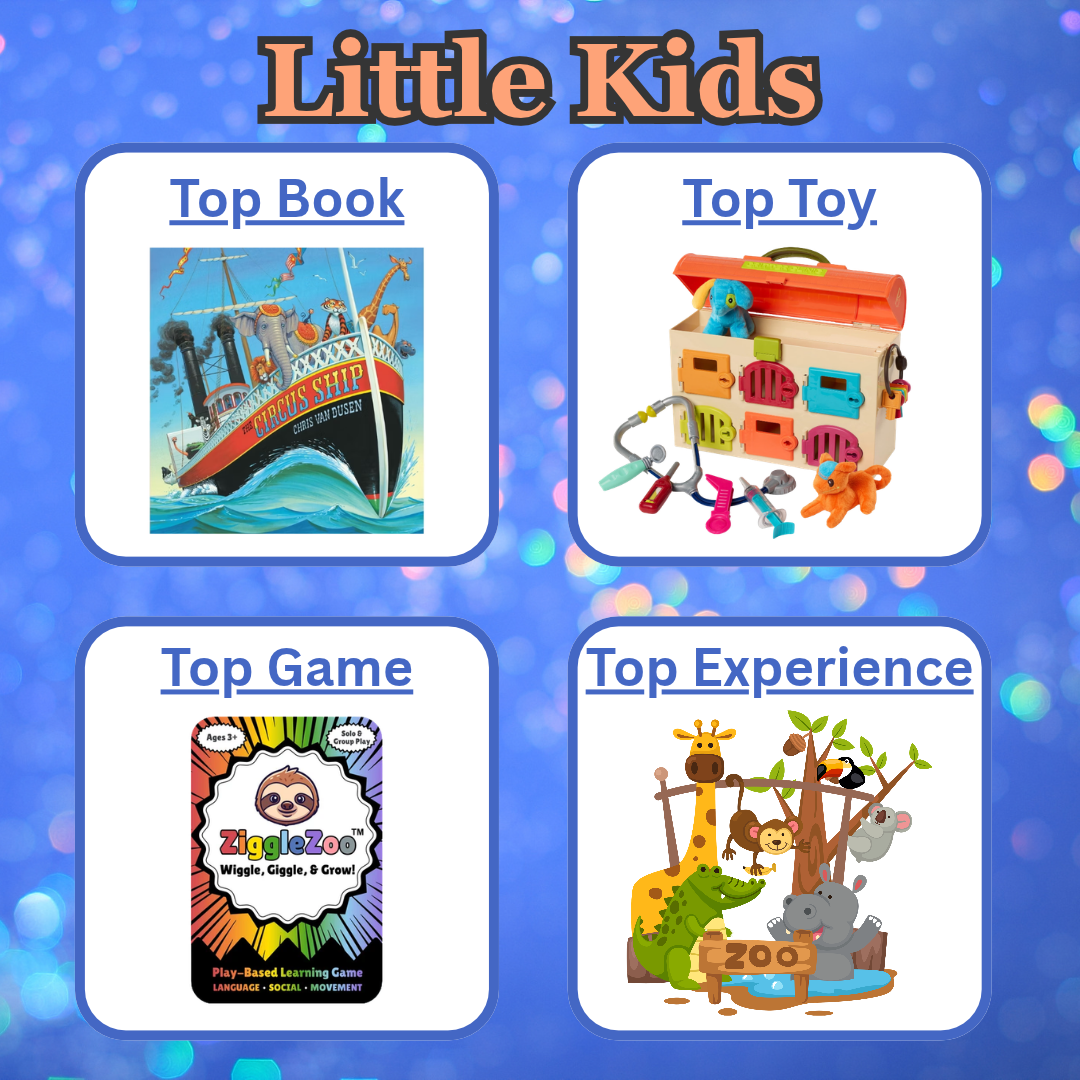
Little Kids
Top book: The Circus Ship, by Chris Van Dusen
With lively rhymes, expressive illustrations, and a story about animals finding an unexpected home, The Circus Ship offers plenty to enjoy and discuss. Its hidden-picture spread invites children to look closely, while the story opens conversations about kindness, cooperation, and belonging.
Try it together: Describe where an animal is hiding without pointing directly to it, giving your child a reason to interpret clues and location words. Wonder aloud about what might happen next or how a character might feel. After reading, use stuffed animals to act out the story, retell favorite moments, or invent a new adventure for the animals.
Top toy: Critter Clinic, by B. toys
This pretend veterinary clinic combines animal care, little doors, matching keys, and medical tools. Its appeal goes beyond opening and closing: it provides a setting for children to create stories, solve problems, and try different roles.
Try it together: Let your child decide what has happened to the patient, then join the story: “Puppy hurt his paw. What could help?” Model useful words such as check, gentle, bandage, better, and worried. Take turns being the veterinarian, pet owner, and receptionist. A simple visit can grow into a longer sequence: make an appointment, explain the problem, examine the animal, and describe how to care for it at home.
Top game: ZiggleZoo
ZiggleZoo brings playful pictures, movement, and language exploration together, giving children opportunities to communicate while being active and imaginative. Its flexible use allows families to follow a child’s interests and adapt participation, from simple actions and descriptions to more elaborate storytelling.
Try it together: Explore a picture and its movement, then add language that matches your child’s level. Name an action, describe what you notice, compare pictures, or imagine what could happen next. You might invent a character, explain how it moves, or build a silly story together. Welcome each child’s own way of moving and communicating, and let the fun guide how much language you add.
Top experience: Membership to a local zoo
A zoo membership makes room for repeated, shorter visits. Returning to familiar animals gives children opportunities to revisit vocabulary, make comparisons, and share observations over time.
Try it together: Before visiting, choose a few animals your child wants to see and look at the map together. During the visit, describe what the animals are actually doing: “The giraffe is stretching its neck to reach the leaves.” Compare movement, size, body coverings, and habitats. Afterward, use a few photos to tell another family member about the visit or make a simple “Our Zoo Adventures” book.
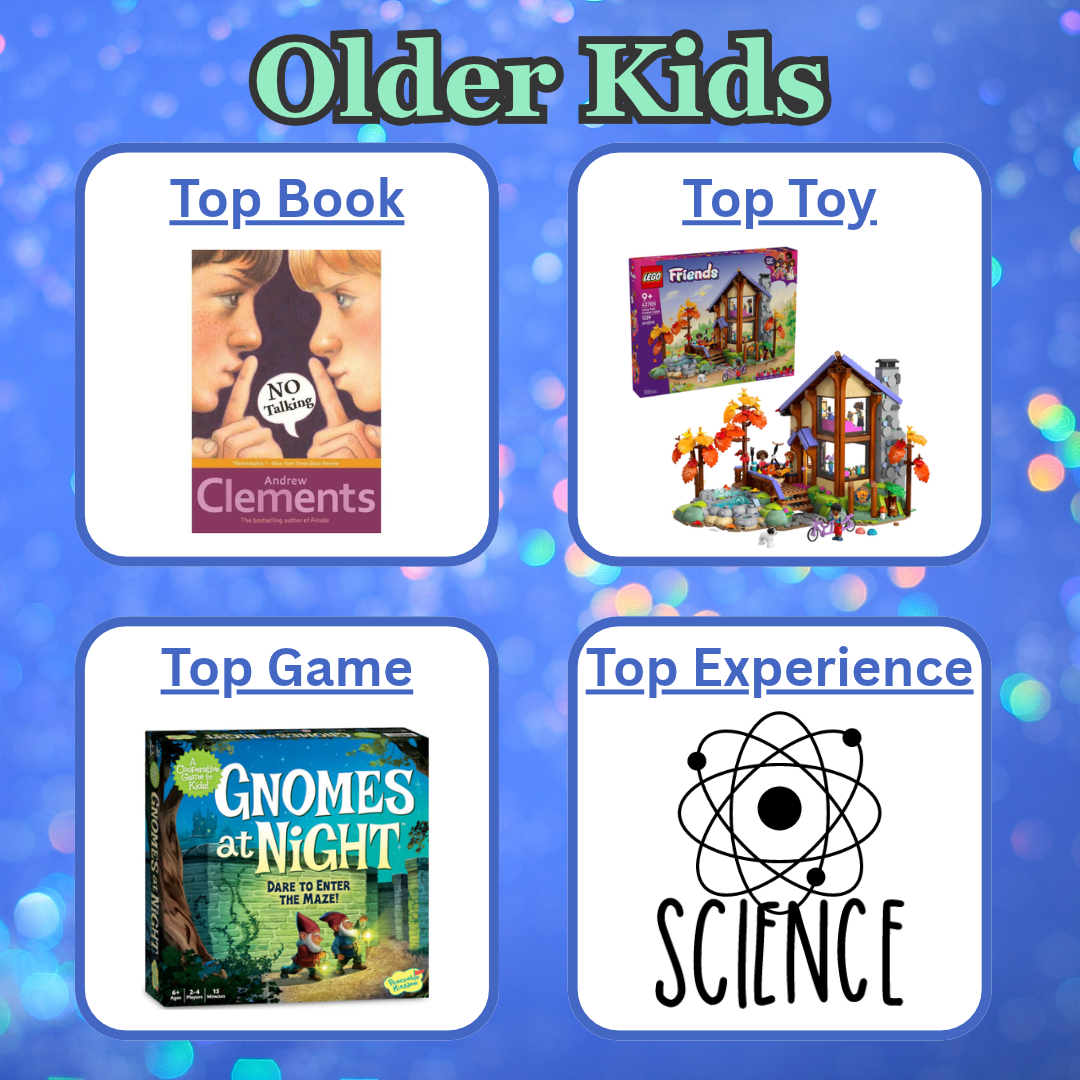
Older Kids
Top book: No Talking, by Andrew Clements
A contest between fifth graders to limit their talking becomes a funny, thought-provoking exploration of words, listening, and communication. The premise gives families a natural starting point for discussing how people express themselves and how language affects others.
Try it together: Discuss what the characters discover about speaking and listening. When do words help? When can they hurt? Try building a shared story by contributing three words at a time, then talk about what made the story easy or difficult to follow. You can also explore how gestures, writing, pictures, and AAC communicate meaning, and why having access to a reliable way to communicate matters.
Top toy: An open-ended building set, such as LEGO bricks
Building materials give children something concrete to plan, explain, revise, and share. An open-ended set offers room for individual interests, whether a child wants to create a dragon habitat, a theater, a spaceship, or an entire imaginary town.
Try it together: Plan a shared construction and negotiate who will build each part. For a playful communication challenge, one person can describe a small structure while another builds it without seeing the original. Compare the results and discuss which details were helpful. Invite your child to give you a tour of a finished creation or invent a story about the characters who live there.
Top game: Gnomes at Night
In this cooperative maze game, players work together to guide magnetic gnomes and recover treasures. Because the players see different sides of the board, sharing clear information is essential to solving the maze together.
Try it together: Practice specific directions such as “Move toward the top edge” or “Stop at the next opening.” Model clarification when needed: “Do you mean your left or my left?” Begin without the timer if that makes the game more enjoyable. After a round, talk briefly about which directions helped and how you worked through misunderstandings. Rephrasing and asking for clarification are useful communication skills far beyond game night.
Top experience: Membership to a local science center
Hands-on exhibits provide something to investigate together and a reason to explain ideas. Repeat visits allow children to return to favorite exhibits, test new possibilities, and build on earlier discoveries.
Try it together: Choose an exhibit that interests your child and share predictions: “I think the wider base will make the tower steadier.” Try different approaches, compare results, and explain what changed. Use words such as predict, observe, compare, and because within the activity. Afterward, invite your child to recommend an exhibit to someone else and explain why it is worth trying.
Tweens & Teens
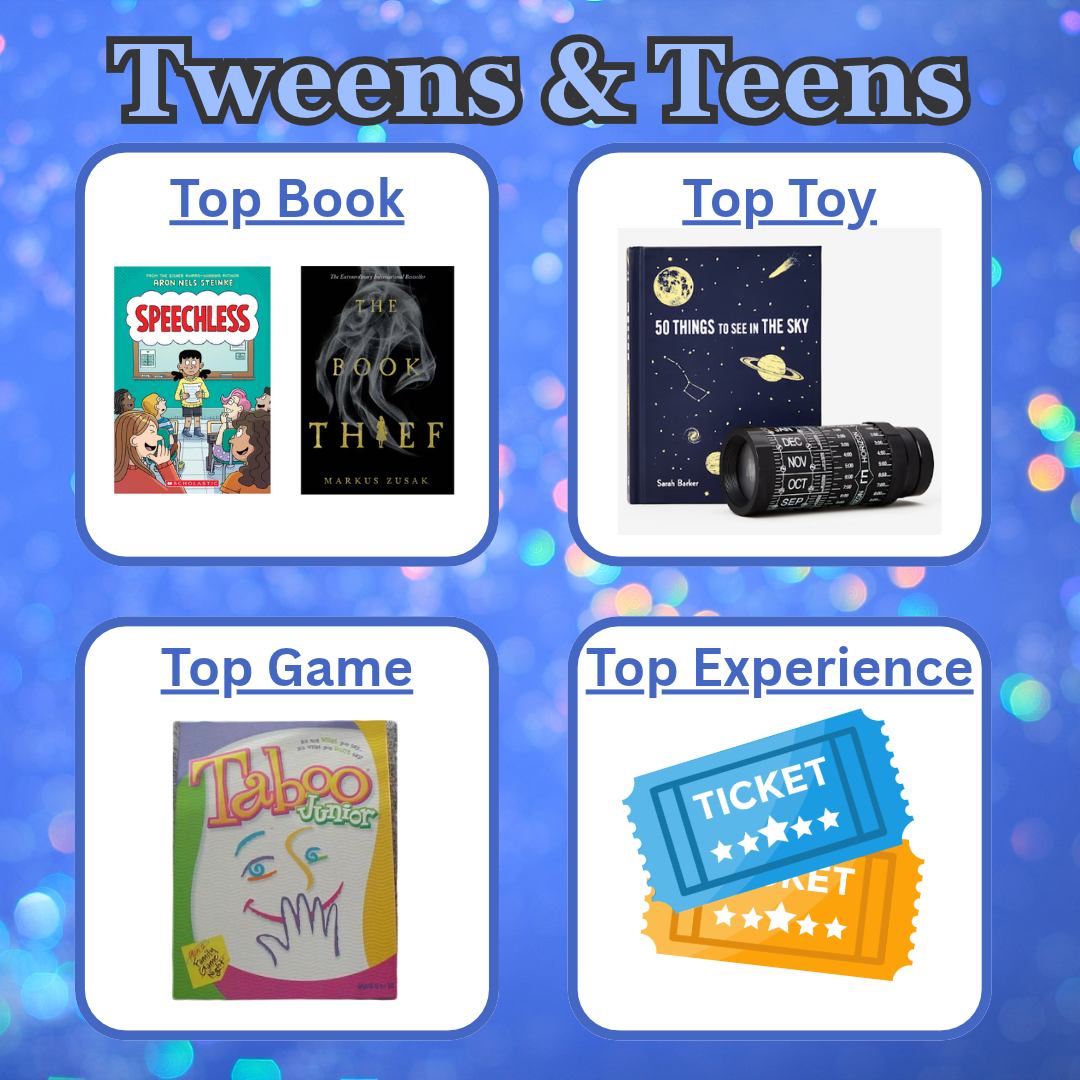
Top book for Tweens: Speechless: A Graphic Novel, by Aron Nels Steinke
This graphic novel follows Mira, who can speak at home but struggles to speak in class, as she navigates friendship, school, and creative self-expression. The combination of pictures and text offers opportunities to consider what a character is experiencing beyond the words on the page. The publisher lists it for ages 8–12.
Try it together: Discuss what the illustrations reveal about Mira’s feelings and what the people around her may misunderstand. Consider what supportive friendship could look like and how creativity can help someone express themselves. Let your child respond through conversation, drawing, writing, or another preferred format, without requiring personal disclosures.
Top book for teens: The Book Thief, by Markus Zusak
Set in Nazi Germany and narrated by Death, this novel offers rich material for discussing storytelling, language, courage, and the influence of words. Its treatment of persecution, war, and loss makes it a choice to match thoughtfully to an individual teen’s readiness and interests.
Try it together: Explore how words are used to comfort, connect, persuade, and manipulate. Discuss how the unusual narrator shapes the story, compare characters’ choices, or consider a passage’s figurative meaning. Share your own interpretations and welcome disagreement—the conversation can be an exchange between readers, without becoming a comprehension quiz.
Top toy: Stellarscope paired with 50 Things to See in the Sky, by Sarah Barker
The Stellarscope is a handheld star-chart viewer that helps users identify stars; it does not magnify the sky. Paired with Sarah Barker’s 50 Things to See in the Sky, it gives curious families a shared reason to look up, investigate, and wonder.
Try it together: Plan an evening of sky-watching, interpret the directions together, and take turns explaining what you find. Explore the difference between an observation, a prediction, and a question. Your teen might research a constellation’s mythology, compare explanations from different sources, or invent a new constellation and tell its story.
Describing a word while avoiding certain obvious clues encourages players to think flexibly about meaning. Taboo Jr. creates a playful reason to use categories, functions, attributes, and associations to help someone else understand an idea.
Try it together: Demonstrate different ways to describe something: what group it belongs to, what it does, where it is found, or what it resembles. Remove the timer or relax the forbidden-word rules when helpful. If a clue does not work, try another approach. This is a fun opportunity to practice explaining an idea in more than one way, including strategies that can help when a specific word is hard to retrieve.
Top experience: Membership, subscription, or tickets connected to an enjoyed activity
Theater, art, music, sports, and other personal interests provide meaningful reasons to communicate. A well-chosen experience gives tweens and teens something they want to anticipate, discuss, and share—and can create opportunities for increasing independence.
Try it together: Involve your tween or teen in choosing the experience, comparing options, and planning the details. They might help write a question to an instructor, explain seating preferences, or invite a friend. Afterward, exchange opinions about a performance, describe a technique learned in class, or debate a turning point in a game. Follow their enthusiasm and leave room for them to become the expert.
Making the Most of Any Gift
You do not need to turn every activity into a lesson. Join your child’s interests, make comments, leave time for responses, and share your own ideas. A child who says “Bear hiding!” can hear you respond, “Yes! Bear is hiding under the box.” A teen who disagrees with your opinion can have space to explain their perspective.
The most valuable part of any of these gifts is the opportunity to enjoy something together—and give each person’s ideas room to grow.
For more ideas about how to build communication into everyday life, contact Stewart SLP.