
ZiggleZoo Card Game

Each ZiggleZoo card game includes 30 pairs of animals on 10 colorful backgrounds (60 animal cards total). Every 4x6 card card features a colorful animal and playful action to build learning & fun! Plus, each deck includes one information card about skill-building and ways to play, along with access to extensive play-based strategies to support development across speech, language, sensory, motor, social, creative, regulation, and health domains.
This bright & engaging card game is perfect for parents, caregivers, teachers, speech-language pathologists, occupational therapists, physical therapists, & counselors.
ZiggleZoo is ideal for play at home, school, therapy, parties, & travel! Skill-building and games are best for ages 1-6+ years with 1-10+ players (including whole classes). It’s fun for adults, too!
Designed by child development expert Nicole A. Stewart, M.S., CCC-SLP, owner of Stewart SLP, pediatric speech-language pathologist, & mom.
Developmental Learning & Ways to Play
Developmental Learning: Building Skills in Play
Speech & Language
Early speech sound production of animal noises & sound effects
Early syllable structures:
1 syllable: dog, cat, fish, frog, mouse, horse, snake, sloth, bird, seal, bee, pig, bear, chick
2 syllables: bunny, starfish, lion, monkey, penguin, cheetah, lizard, spider, giraffe, owl
3-4 syllables: flamingo, gorilla, elephant, alligator, octopus, kangaroo
Vocabulary of concepts (animals, body parts, colors, counting), actions (run, jump, wiggle), & opposites (move in contrasting sets of fast/slow, big/small, quiet/loud)
Sorting by color and animal habitats
Farm: horse, pig, chick
Zoo: monkey, gorilla, lion, flamingo, penguin, cheetah, elephant, giraffe, sloth, kangaroo
Water: frog, starfish, lizard, octopus, seal, alligator, fish
House Pets: dog, cat, bird
Forest: mouse, bunny, owl, bear
Garden: bee, spider, snake
Early sentences: dog shake, green frog, fast cheetah
Definitions & descriptions using categories with salient features
Sensory & Motor Skills
Balance: Complete actions using the whole body before acting out movements using first one side and then the other. Hold positions to improve balance.
Coordination & movement sequencing: Complete movements in a variety of 2-5+ animal sequences (cat/bear/horse; frog/giraffe/bunny) to develop complex motor planning.
Physical awareness and control through the use of targeted movements and/or whole-body movements
Sensory processing:
Visual system - bright colors and clear images keep learners engaged
Auditory system - pairing movements with animal noises, language models, and/or verbal directions improves sound detection and interpretation
Vestibular system - processes motion, head position, and spatial orientation to maintain balance and posture
Proprioceptive system - sense body position, movement, and acceleration in space
Interoception: awareness of internal sensations like heart rate, hunger, and breath
Muscle strengthening through repeated movements and sequences over time
Social Skills & Creativity
Social awareness, self-awareness, and confidence through intentional movement
Imitation of spoken language (sounds, labels, actions, sentences) and movements (gross motor, fine motor, & motor planning)
Opportunities for introducing, teaching, and practicing turn-taking routines
Social referencing while visually and/or verbally checking in with others while playing
Role play & pretend sequences — Pretend to be different animals encountering each other and deciding how to interact (Will the bear chase the frog or make a new friend?)
Social enjoyment & collaboration with peers and/or adults
Individualize each child’s tolerance for losing games by choosing Ways to Play that focus on cooperative play, competitive play, or both!
Social flexibility with multiple activities and Ways to Play! Make up your own games or rules, too!
Playdate fun! Use ZiggleZoo to break the ice and utilize time when playing with friends.
Regulation & Health
Indoor active entertainment at home, school, or travel
Short movement breaks improve attention & focus
Longer play provides physical exercise and/or social fun
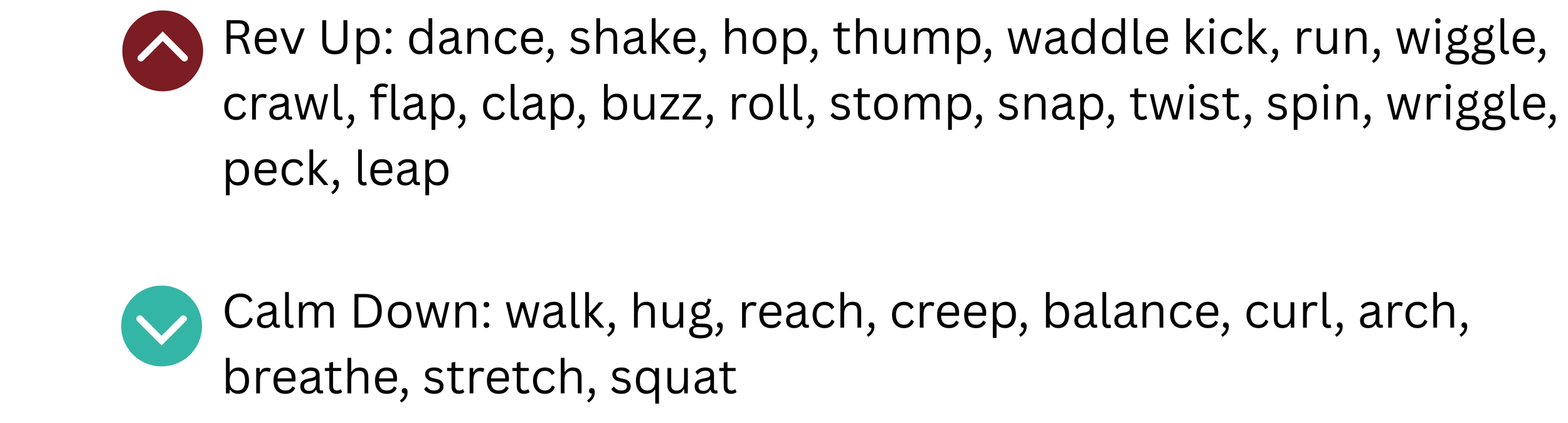
Regulate (Rev Up & Calm Down symbols on cards):
Proactively set children up for regulation by building 5-10 minutes of ZiggleZoo into daily lifestyle routines. Consider ZiggleZoo in the morning to get the day started right and/or after school to reset for a successful evening.
While holding static poses (squat, balance, curl, etc.), take 5-6 slow, deep breaths to focus on body awareness, reduce overwhelm (anger, excitement, anxiety), and build emotional resiliency.
Ways to Play: Home, Classrooms, Parties, & Travel
For 1+ Player
Flip Out — Shuffle your desired number of cards into a single, upside-down deck (or make a deck for each player, if you prefer). Flip over the top card and GO! Move your body, make some noise, and have a blast! This game can be done solo, in turns, or simultaneously. Keep playing until all the cards are turned over and you’re happily flipped out!
Rainbow Rush – Find one animal from each of the 10 background colors. Lay the 10 cards from left to right in rainbow order. Starting at the left side, work down the row to act out each animal’s action for 10 seconds.
Color Combos – Find the three different animals with the same background color. Try acting out the animals’ movements back-and-forth in different combinations. As a bonus challenge, attempt to act out all three actions at the same time!
Scavenger Hunt – Hide animals around your space. Gather your explorer materials (flashlight & bag) to find the hidden animals. Be sure to greet each animal by copying their movements as you find them!
Jungle Obstacle Course – Lay out pillows, blankets, mats, and hula hoops around your space. Set a different animal card at each station. Ready, set, go! Run to a station and act like that animal for 10 seconds. Then rush to another station. Continue until you have completed the course.
Memory – Select 3-10+ animal card pairs, shuffle the cards, and arrange them face down in rows and columns. A player flips two cards face-up for all to see. If the cards match, the player keeps the pair, acts out the animal action, and takes another turn. If they do not match, they are flipped back face-down in the same spot, and the turn passes to the next player. The game ends when all pairs are found; the player with the most pairs wins. Pay close attention to cards flipped by other players to remember their locations. For solo play, play the same way but try to find all pairs in the fewest number of turns possible.
Zoologist — Pick an animal card and do some research to learn more about your animal. Where does it live? What does it eat? Who lives in its family? How does it play? Do your research with an adult at school, a library, or online. Then, make a report about your animal to share!
Animal Kingdom — Pretend to be an animal in your own kingdom. What will you do? Where will you explore? Who will you find? How will you play? Pretend alone or with some friends!
For 2-10+ Players
Leader Learning — Leaders (parent/caregiver/teacher/therapist) flip over cards to focus on focused skill-building. Leaders can choose to target speech/language, sensory/motor, social/creativity, and/or regulation/health in teaching activities.
Furry Freeze Dance – The Leader will flip over an animal, show the group, and turn on some music. Everyone dance like that animal until the Leader stops the music! Freeze for 1-2-3 seconds! Then, the Leader will flip over the next animal, resume the music, and freeze again!
Pawsome Charades – Shuffle your desired number of cards into a single, upside-down deck. On your turn, draw a card and keep it secret. Set your card to the side, and start moving like your animal. Keep going until others guess who you are. As a bonus challenge, try not to make any sounds!
No Peeking – Pick a secret card, describe clues about your animal, and see if others can guess it. Think about giving information about where your animal lives, what special body parts it has, and what it likes to do. Once the animal is guessed, reveal the card and act like that animal!
Go Fish – Deal 5 cards to each player. The remaining cards form the "pond" in the middle. On your turn, ask one specific player for an animal already in your hand. If they have that animal, they must give you that card. You get another turn. If they do not have the card, they say "Go Fish." Draw from the deck. If you draw the card you asked for, you show it and take another turn. If you draw a card that does not match what you asked for, your turn ends. When you collect both cards for an animal, lay them down and act out the animal action. The game ends when all cards are matched or one player runs out of cards. The player with the most matches wins.
Critter Corral — Pass out secret animal cards to each person using matching sets of animals. When the leader says, “Go!”, each person rushes to find the other animals that match their card. The first team to find all members and act out their animal’s action wins! Best for groups of at least three animal pairs (6 players).
Creature Contest — The Leader stands at one end of the play space, and children line up side-by-side at the opposite end of the play space. The Leader holds up one animal card. All children perform ONE movement of that animal (e.g., one bunny hop, one frog squat, one penguin waddle). Some movements will be done in place while others will have forward movement. The Leader will keep showing new cards until all children reach the Leader.
Predator Prey — Draw two animal cards and have each person act out one of the two animals. Without touching each other, decide which animal would win in a match-up based on how they move. Give at least one good reason to support your choice.